
If you’re on Pinterest, please pin this graphic if you liked this post.
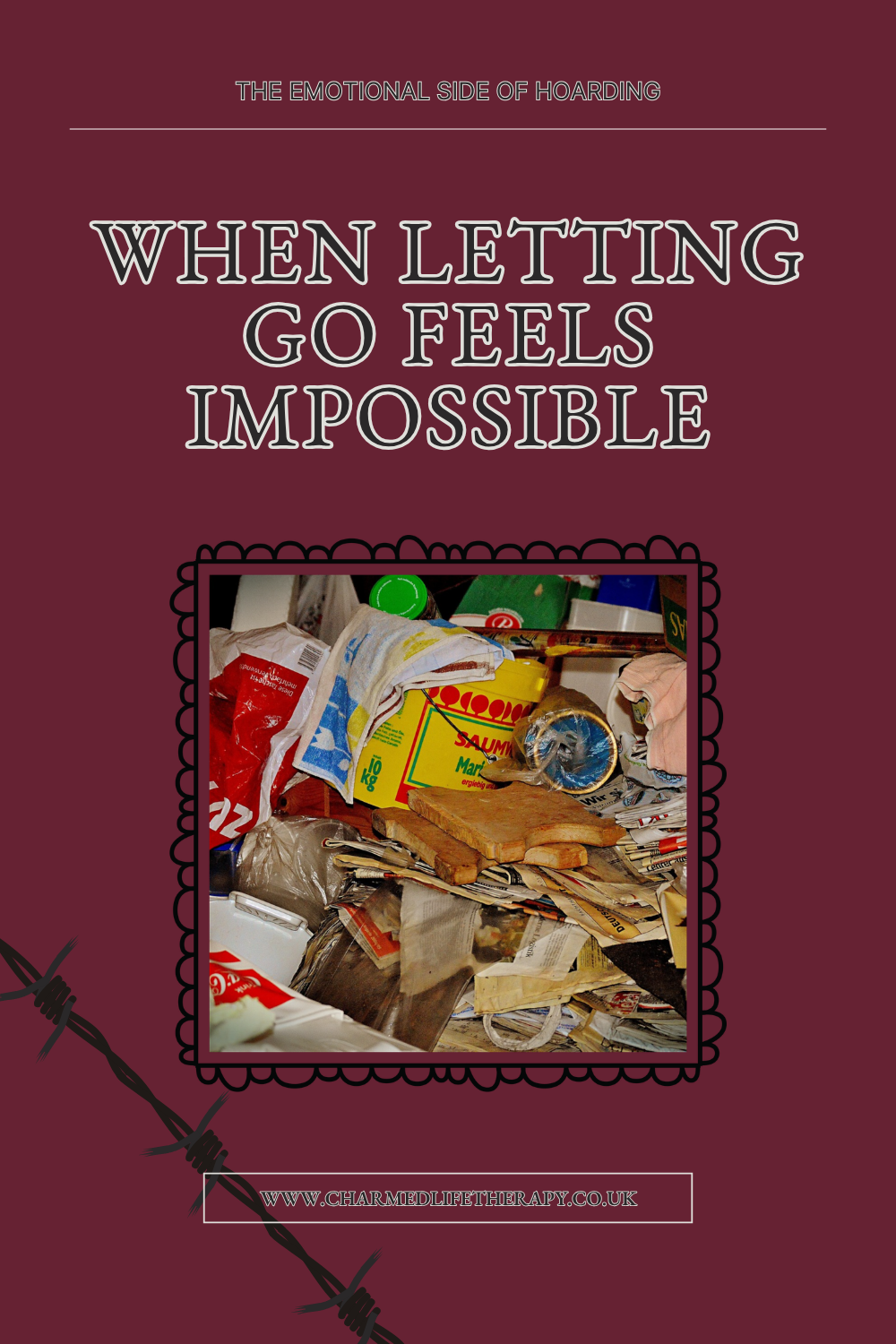
Why clearing the clutter can sometimes mean understanding what's happening beneath the surface.
Hoarding is starting to be a little better understood these days…
(Reproduced from March 22nd 2024)
But to people experiencing it, it can be very embarrassing and life-limiting. It can lead to feelings of supremely low self-esteem. People may feel disgusted with themselves, ashamed, overwhelmed, and caught up in all the emotions that can make someone feel as though they've lost all sense of hope. They may also have become loners, because the shame can be so great that nobody is allowed to come into their homes. Slowly, they become isolated or cut off from others.
Then there are those who have family and friends, and get to enjoy the constant criticism, nagging or misplaced, well-meaning encouragement.
‘Why don’t you just…’
‘How about you just try…’
‘But I can’t understand why you just don’t…’
‘I know. Just get out the garbage bags and make a start.’
Amazing! Why didn't you think of that for yourself? It seems so simple to the bystander.

But hoarding is rarely as simple as a lack of motivation or an inability to organise. There can be deeply personal reasons why someone can buy black bin bags, cleaning products and brand-new empty boxes, and then never use them. Those things can themselves become part of the accumulation.
When the situation reaches a certain level, a person may stop picking things up altogether. Even sweeping loose dust, dirt or something dropped a year ago can feel terribly hard. And if you do pick up that one thing, what's the point? There is so much other stuff that the one tiny thing everybody tells you to start with just won't make a blind bit of difference.
You are in full-on overwhelm. Freeze mode.

Eventually The House Starts Falling Down Around Your Ears
Things break down, rot, leak, burst, and disintegrate. It's too embarrassing to have repairmen call round. Pests and bacteria may move in and start breeding. You can't find anything. The house feels like it's playing tricks on you. Ghosts lurk in corners.
Your mind feels like it's not your own anymore because you can't think straight. All that confusion makes it even harder to contemplate making a start on clearing anything out. Your thoughts feel as muddled and confused as your living space. And it all feels so terribly, terribly hard.
Then you start to feel as though you don't deserve anything better, because look what you've done to yourself.
And you're scared to death of who might find out, who might report you, and what you might lose. If you have animals, will someone take them away? So you start living in abject fear, too.
For some people, hoarding can be connected to an inability to cope with any more loss in their lives. Even if the loss in question appears to be a bunch of rubbish accumulated over years, or some loose dirt that somebody else would simply take a dustpan and brush to without a second thought. This is what people can find so hard to understand.
People who hoard are not some strange breed of human being. They may be perfectly capable, organised and competent in other areas of their lives. They can be very tidy and organised in their place of employment, and nobody may suspect a thing.
That in itself can become another source of fear. They desperately want to hang on to their secret, and to the little bit of respect and good public standing they feel they still have. So it becomes very difficult to ask for help, because doing so can feel like losing the last part of their lives they have control over.

There Should Be No Shame Attached to Hoarding

Hoarding can feel like wearing the cone of shame in your own home.
So, back to the possible origins.
Hoarding can be associated with experiences that have rocked someone to their core, whether that happened in a single event or developed over decades. There is often much more going on than the possessions themselves. Grief, trauma, anxiety, deprivation, loss, attachment and a need for security can all play a part. The reasons are personal, and there is no single explanation that applies to everybody.
I find it hard to imagine that many people who hoard would genuinely choose to live with the shame, isolation and practical difficulties that can accompany it. For many, it is a situation they feel trapped in rather than one they actively want.

I have had personal experience of working with a client whose difficulties included severe hoarding. It was a particularly challenging situation, not just because of the volume of possessions, but also because of the hazardous state of cleanliness and safety.
This person had experienced a lifetime of severe abuse, personal hurt, grief and lost opportunities, stretching right back through her upbringing and eventually to losing her parents in her fifties. By that time, a great deal of emotional damage had been done, and deeply ingrained, harmful beliefs had taken hold.
As can happen for other people, there were many mixed emotions around letting go of possessions that had belonged to those she had lost. Sometimes, the thought of parting with them felt impossible, even when traumatic memories were attached to them.
My client had a deep sense of responsibility to uphold her parents' expectations of her, long after they had died. This was connected to the way she had been conditioned throughout her life.

Too Many People Are Still Carrying the Burden of Previous Generations

The chaos in your mind extends to your home. Heal one and heal the other.
A great proportion of people suffer from such generational conditioning. And all of that accumulated ‘stuff’ can become something of a protective device. It protects you and it protects a fragile version of the past. A narrative you were taught in some cases. It can be both your jailer and your protector.
People who have been hurt can sometimes find comfort in surrounding themselves with possessions. The accumulation may provide a sense of safety, familiarity or control. It can also offer a way of hiding from the world, of not being seen or hurt again.
That is one reason why picking up ‘the one thing’ can feel impossible. It may bring up a sense of exposure or danger that is completely out of proportion to the object itself. Removing it can trigger an intense emotional response. If the person feels compelled to replace it, why would they choose to get rid of it in the first place?
So hoarding can have ties to grief, wounding, self-preservation and survival. None of these are small things.
Understanding what may be happening beneath the surface can be an important part of finding a way forward. Somebody could go into a person's home, do a total overhaul and leave it spotless and organised to the minutest detail. But if the emotional difficulties associated with the hoarding remain unaddressed, the person may still feel overwhelmed, unsafe or compelled to accumulate more possessions.

A tidy home does not automatically mean that the person living in it feels better.
Hoarding can also extend beyond the home. It may show up in cars, on phones and computers, or in other areas of life. Anywhere there is an opportunity to store and accumulate, the same patterns may appear. Sometimes, filling every available space can feel safer than leaving room for the unexpected.
Remember, your mind likes what is familiar. Even when something is causing distress, it can still feel safer than the unknown. For someone who has been through difficult experiences, the possessions and the patterns surrounding them may have become deeply familiar. Those beliefs and associations can be worth exploring.
And this is where therapeutic approaches may have something to offer.

Hoarding Is Heartbreaking

An assortment of issues can lead to an assortment of ‘stuff’
I was very pleased with the progress my client made through our work together. We used RTT and the Rewind Technique as part of an individualised approach, working carefully and at a pace that felt manageable.
The Rewind Technique was used in relation to a separate, immediate external threat to her physical safety. The RTT sessions gave us an opportunity to explore some of the beliefs and experiences that were relevant to her situation.
We approached the work tentatively. We were mindful that exploring painful memories and emotions too quickly could feel overwhelming, and that it was important to respect what she felt ready to work on.
The progress she made was remarkable.
But it is important to understand that this was one person's experience, not a formula or a promise of what will happen for someone else. Hoarding is complex, and the right support will depend on the individual, their circumstances and the nature of their difficulties.
For my client, the work was accompanied by a growing sense of possibility. By the time this article was written, she had a skip at her home. She was cleaning, taking things to the charity shop and recycling centre, arranging for workmen to quote for repairs, making plans and dreaming about how she wanted her home to look.
There was an eagerness to finish what she had started, to choose paint and pictures, and to create a real haven for herself for the first time in her life.
For most people who hoard, their circumstances will not be anything like those of the client I have described. But that doesn't make their difficulties any less important. She needed to approach things in a way that felt manageable and on her terms, particularly given her history of having very little permission to enjoy normal human freedoms.
For her, some of the healing involved acknowledging what had been done to her by those whose job it was to love, nurture and give wings to her dreams, goals and aspirations. None of which she had received.
There can be initial guilt, an unwillingness to allocate blame, and even self-directed anger. These are some of the emotional themes that therapeutic work may be able to explore. And it is important that appropriate support is available. A person may initially feel very exposed when they begin to question patterns that have been part of their lives for a long time. Remember, the accumulation may have become an important protective device.
Of course, everybody's experience is different. The emotional responses involved can be complicated, and it is important not to make assumptions about what someone is thinking or feeling. With the right support, those feelings can be explored at a pace that feels safe and manageable. Recovery can feel like a mountain to climb before you even make a start. But change is possible, and the first step doesn't have to be a dramatic one.
Hoarding is unlikely to be resolved through a single therapy session. It is important to tailor any therapeutic support to the individual, and to recognise that practical help may also be needed. The chaos in your mind can sometimes extend to your home. Understanding what is happening emotionally may help you begin to approach both differently.
The Emotional Support Behind Making Progress
Through my experience, my instinct is that people facing deeply entrenched patterns and emotional overwhelm may need a good level of support alongside any therapeutic work. Especially if they have very little support in their lives already.
This is where my existing work may be relevant.
I don't offer a dedicated hoarding treatment or a house-clearing service. What I do offer is a range of therapeutic approaches that can be applicable to some of the emotional patterns that may sit underneath difficulties with letting go, feeling safe, making decisions or moving forward.
Depending on the person and what they want to work on, this might include Rapid Transformational Therapy (RTT), the Rewind Technique, focused hypnosis, conversational reframing or other approaches.
With RTT, for example, we may explore experiences and beliefs that have contributed to the way someone sees themselves or the world around them. We can look at how those beliefs might be influencing present-day feelings and responses, and work towards developing healthier, more helpful perspectives.
A personalised recording can reinforce the ideas and suggestions that are relevant to the person's goals. That might involve feeling more capable, confident and safe; developing a greater sense of motivation; or finding it easier to approach something that previously felt overwhelming.
The focus would not be on making somebody suddenly throw things away. It would be about the changes they themselves want to experience, and what might help them feel more able to move towards those changes.

Many people experience a lot of comfort and clarity through just having a short, free call with me.
An Individual Approach to Healing from Hoarding
Whatever approach is appropriate will depend on the individual circumstances. I like to use language and imagery that mean something to the person, and that appeal to their interests and imagination, too.
We can install a cheerleader, a superhero, a best friend who motivates and loves you, if necessary. Words are my thing! Treatment can be about breaking up the relationships between feelings, sensations and the way you store and process memory. Sifting through the layers and making manageable tweaks.
And sometimes, it may be perfectly fine for the past to remain the past. We don't always need to uncover every memory or know the reason behind every pattern to work towards a different experience in the present.
The important thing is that the work is relevant to the person, their needs and the outcomes they want.
If you or someone you love is living with the painful and limiting effects of hoarding, there may be a way forward. It may involve a combination of practical, specialist and emotional support, depending on the situation.
My first client made remarkable progress and eventually felt able to take on the task of clearing and cleaning her house herself. Her response was nothing short of incredible. But one thing that mattered was her commitment to the process. She trusted that, by continuing to work at it, things could change.
I Can Be Trusted Not to Give Up on You
I will admit I’m a bit tenacious when I'm on your side!
What I can offer is a thoughtful, individual approach to the emotional and subconscious patterns that may be contributing to the difficulties you're experiencing. We can explore what you want to change, what feels possible and which of my approaches might be appropriate.
This kind of work is not a substitute for practical assistance, specialist hoarding support, or help with any health, safety or housing concerns. Sometimes those things need to happen alongside emotional work, and there is absolutely no shame in that. If you'd like to find out whether working with me might be helpful, you can book a free, no-obligation introductory call.
We can talk about what's happening for you, what you'd like to be different, and whether my services might be a good fit. We can also discuss the practicalities, including the kind of support you're looking for, timescales and affordability.
After appointments, I provide email and message support as part of my service. You're not simply left hanging or uncertain about what happens next.
And it's important to understand that having hypnosis does not mean you'll suddenly be expected to jump up and start throwing out everything you've accumulated. There is no pressure to comply with deadlines or to work at somebody else's pace. Any therapeutic work would be on your terms, with your own goals in mind.
And actually, this isn't even about whether you personally clean and sort out your home, or whether you feel energised and motivated to hire somebody to do it on your behalf. The practical arrangements are yours to decide.
I don't need to see what condition your house is in unless you choose to share that with me. We can focus on the emotional changes you want to work towards, without making assumptions about what your home looks like or what you should be doing with your possessions.
Let the Air Circulate Again - In Your Mind and Your Life
That first client of mine described the experience as having the window cracked open in her mind and allowing all the hope and sunlight in.
Basically, you will feel like you can breathe again and come up with a plan. And I can be there to offer encouragement and support along the way. Pep talks, talking you down or talking you up! Whichever is necessary.
We can explore the past and work on reframing and rewiring unhelpful beliefs, or we can focus more directly on the changes you want to make now. Sometimes it's perfectly fine for the past to remain the past. We can discuss together what feels right for you.
Love The Mind Detective
Anne-Marie x 🕵🏻♀️ 🧙🏻♀️


Everyday ways your language shapes your view of your life.